RMA Statements of Principles (SOPs) for DVA Claims — Plain-English Guide
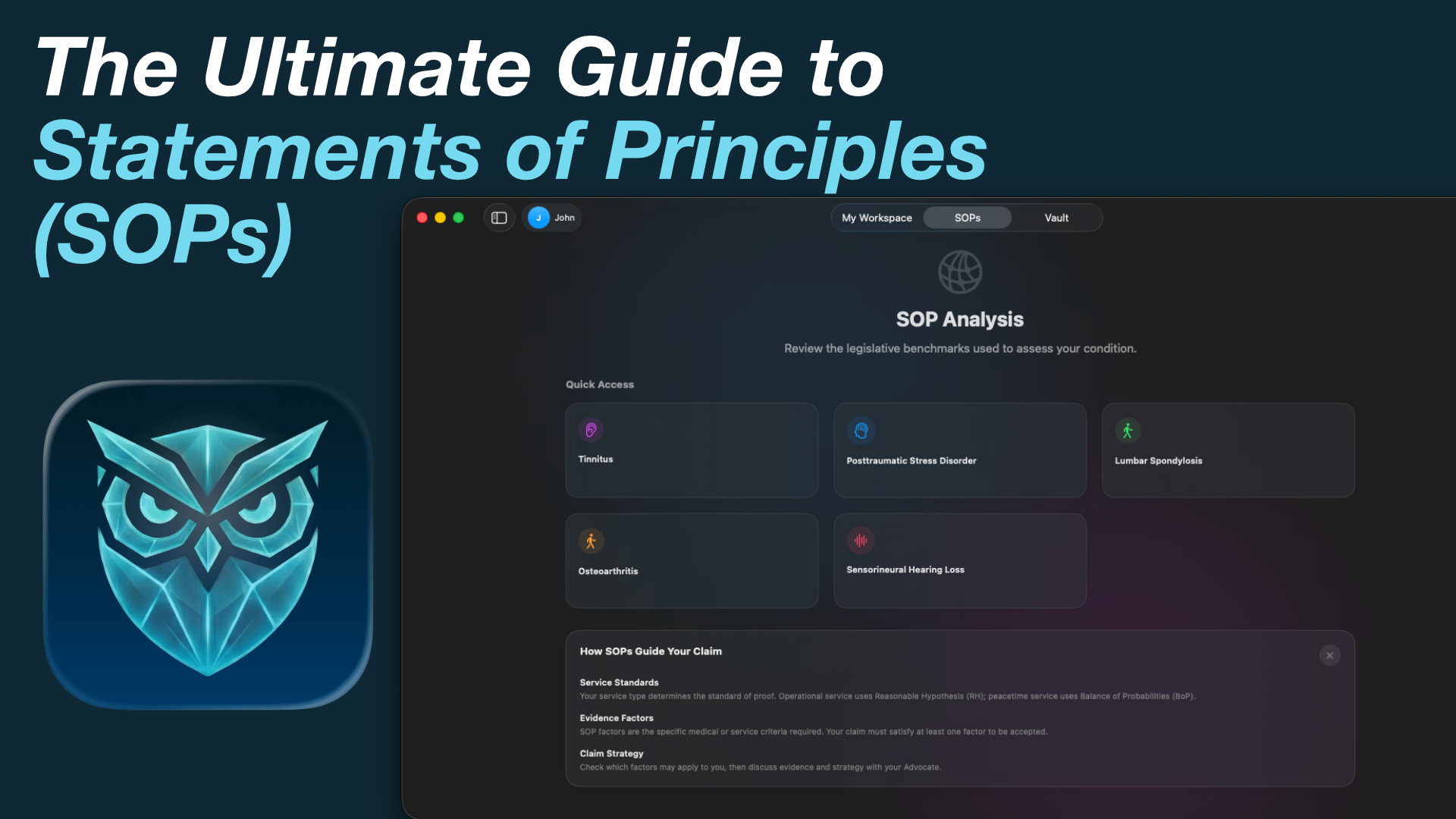
If you're an Australian veteran or an advocate assisting with a DVA (Department of Veterans' Affairs) claim, you'll encounter the term "SOP" frequently. SOPs, or Statements of Principles, are the backbone of most DVA liability decisions. Understanding them is critical — but interpreting factors across a large library can quickly become overwhelming.
This guide breaks down what SOPs are, how to interpret their factors, how they sit alongside the July 2026 presumptive pathway, and how to match medical history to the right criteria without drowning in PDFs.
What are SOPs and why are they critical?
The Repatriation Medical Authority (RMA) creates and maintains Statements of Principles. A SOP is a legislative instrument that sets out the factors that must as a minimum exist to cause a particular disease, injury, or death.
In simpler terms: SOPs define what criteria must be met for DVA to accept that a condition is related to a veteran’s service under the SOP pathway.
When you submit a claim on that pathway, DVA doesn’t just look at whether you have a diagnosed condition. They look at whether your service history aligns with the specific factors listed in the relevant SOP. Miss the right factor — or the right timeframe — and the claim is at risk.
The RMA currently publishes 761 SOP instruments covering 382 conditions — 10,632 factors in total, all available in Athena’s offline library. They are regularly updated based on the latest medical science.
How to interpret RMA factors
Each SOP is divided into distinct sections. The most important section for claimants and advocates contains the “factors” — the specific events, exposures, or circumstances that must have occurred in connection with service.
When interpreting RMA factors, keep these points in mind:
- Exacting language: SOPs use precise medical and legal terminology. A “severe psychosocial stressor” has a defined meaning inside the instrument that differs from everyday use.
- Timeframes: Many factors require an event within a set window before clinical onset. Evidence outside that window does not meet the factor.
- Standard of proof: There are typically two instruments for each condition — Reasonable Hypothesis (operational service) and Balance of Probabilities (peacetime service). Use the correct one for the service type.
SOPs and presumptive liability (from 1 July 2026)
From 1 July 2026, presumptive liability runs as a parallel pathway for 247 listed conditions when service criteria are met. It does not replace SOPs. Many claims — conditions outside the list, sequelae strategy, or cases where presumption doesn’t apply — still turn on SOP factors. Keep both toolkits ready. Start at the presumptive liability 2026 hub.
The challenge of matching medical history to SOPs
The hardest part of a claim often isn’t obtaining records; it’s matching a lifetime of medical history against rigid SOP criteria.
A typical file might include hundreds of pages of discharge summaries, specialist letters, GP notes — and a JeHDI export or scanned UMR. You must extract diagnoses and dates, then cross-reference them with the relevant factors. You also need to understand sequelae: how one accepted condition can legally connect to another.
That process is slow and error-prone. A single missed note buried in a giant PDF can mean the difference between acceptance and appeal. For the Defence-records side of that problem, see how to read your UMR.
How Athena helps: SOP Navigator (and more)
Athena’s SOP Navigator keeps the full RMA library on your Mac or iPad — 10,632 factors — so you can search securely on your device instead of tabbing between binders and the RMA website.
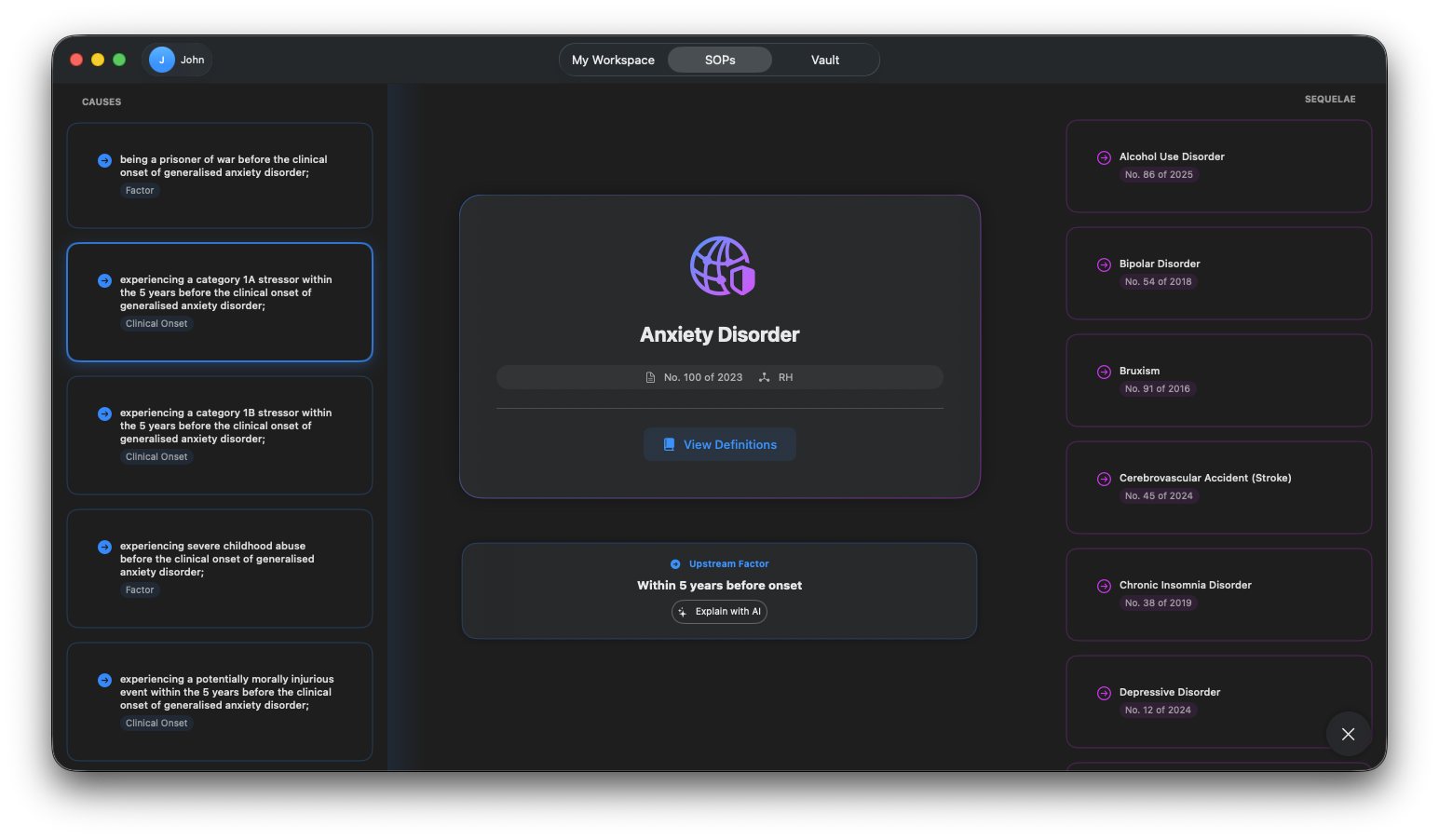
- Search by condition or SOP: Open factors clearly laid out, with plain-English summaries alongside the source text.
- Definitions on tap: Instantly see how specialised terms are defined in the instrument.
- Sequelae links: Explore related conditions; for complex chains, advocates can visualise the logic on Strategy Maps.
- Stay current: RMA updates are pushed to your device, with plain-English notes on what changed.
- Lodgement-date pathways: Athena applies the correct legislative pathway based on when the claim is lodged — including unified MRCA rules from 1 July 2026 where they apply.
- Privacy: Search terms, conditions, and claim strategy never leave your device.
Pair SOP research with the Evidence Vault so medical excerpts and factors live in the same private workspace.
Stop wrestling with PDFs and cloud privacy risks.
Map evidence to SOP factors securely on your device. Available exclusively on the App Store.