The Intelligence Dilemma: Navigating the Trade-off Between AI Speed and Data Sovereignty in DVA Claims
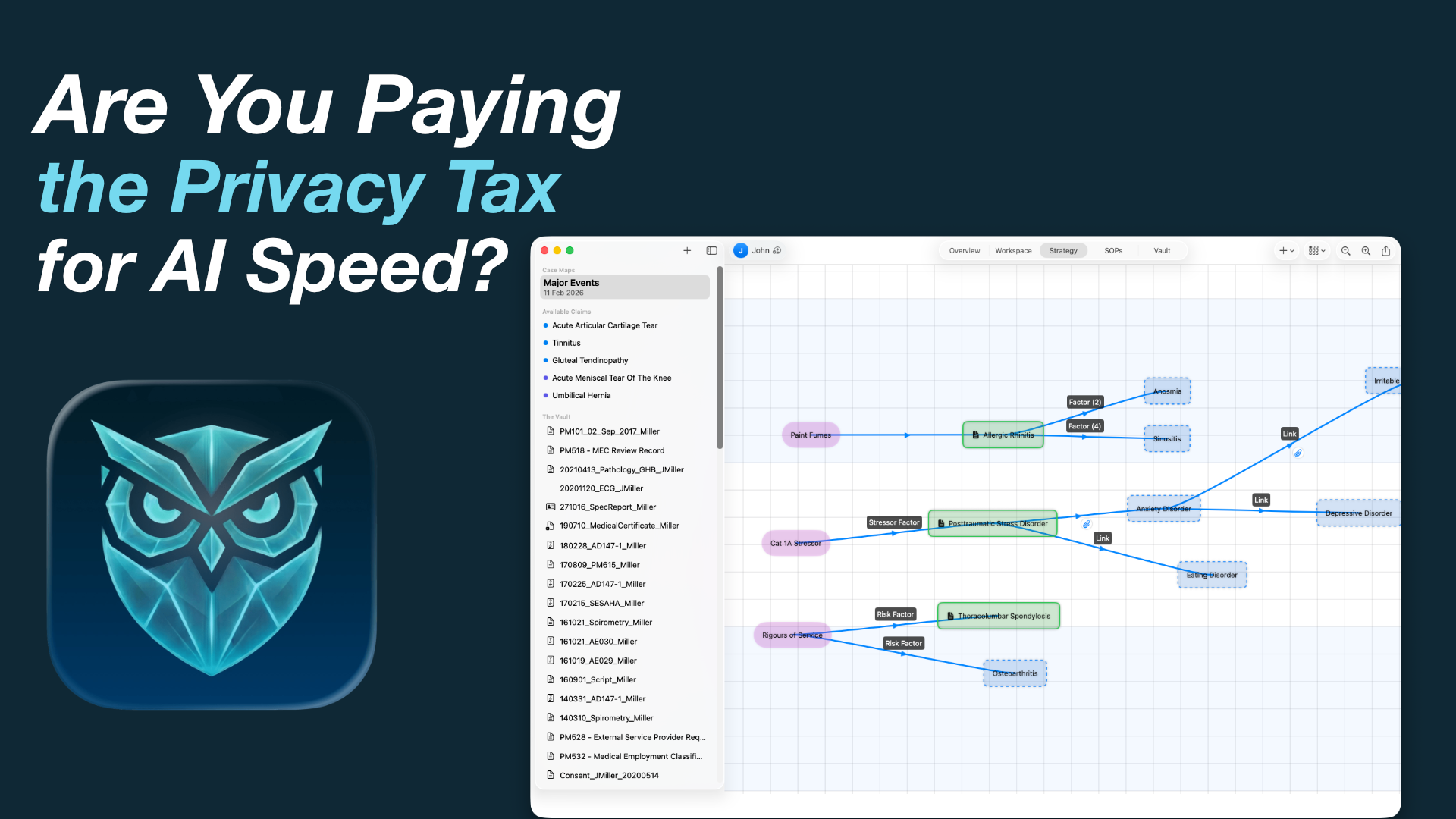
Problem: Cloud AI offers speed for DVA claims, but uploading medical evidence, service records, and trauma narratives means surrendering privacy. Solution: Athena delivers local-first intelligence — AI that runs securely on your device, so claim data never needs to leave home.
The new era of claim management
Large Language Models have changed how we interact with complex information. For Australian veterans and advocates, the benefit is real: AI can summarise a thousand-page medical report in seconds and surface patterns in service history that would take a human weeks.
As a result, people are increasingly comfortable — even eager — to upload sensitive information into cloud AI services. They have felt the speed, and they are willing to pay a “convenience tax” to get claims moving.
But a harder question follows: When the data is the most intimate history of your life, what is the true cost of that convenience?
The privacy tax
In a DVA claim, we are not talking about a grocery list. We are talking about the vault of a life:
- Detailed medical histories and psychological assessments
- Service records and deployment timelines
- Private family histories and personal trauma narratives
- Defence health releases — JeHDI exports or scanned UMRs — that can run to hundreds of pages
When this data is sent to a cloud AI, it exits your control. It is stored, processed, and — depending on the provider’s terms — potentially used to train future models.
Even with “enterprise-grade” security, the risk remains: data in the cloud is data you can no longer personally protect. For a veteran, the privacy tax isn’t just a subscription fee; it is the loss of sovereignty over their story.
The third way: local-first intelligence
At Athena, we believe you shouldn’t have to choose between intelligence and privacy. The false choice is:
- Manual labour: exhaustive, slow, and prone to human error.
- Cloud AI: fast, but requires surrendering your data.
We propose a third way: local-first intelligence — the reasoning power of AI, with evidence processed securely on your device.
That is Athena’s architecture, not a bolt-on setting. Your medical records, SOP research, and claim strategy stay on hardware you control — processed locally, with no dependency on a live connection to work.
The role of Athena: extract, structure, build
Be clear: Athena is not a doctor. Athena is not an advocate. It doesn’t replace medical expertise or the judgement of someone fighting a claim.
Athena is here to extract, structure, and store your evidence — then, using the real SOP (and presumptive) content and what you’ve imported, help you build and iterate a case as many times as you need.
The most common reason for rejection is not a lack of medical evidence, but a failure of connection — linking condition, service, and the rigid logic of the Statement of Principles (or confirming a presumptive route) in a way a Delegate can see.
Athena bridges that gap by:
- Unpacking noise into structure: Turning JeHDI exports, scanned UMRs, and civilian PDFs into a searchable Evidence Vault — split into real clinical records where the release allows.
- Decoding the bureaucracy: Navigating 10,632 SOP factors (and presumptive checks) so documentation speaks DVA’s language.
- Building the chain of connection: Helping you document how condition, service, and factors link — including interactive Strategy Maps for advocates.
Privacy first: intelligence that stays on your device
Athena solves the intelligence dilemma without the privacy tax. Sensitive DVA medical evidence stays on your iPad or M-series Mac. On-device AI extracts, structures, and helps you build the claim — privately, offline-capable, under your control.
Learn how Athena’s on-device privacy model works →
Practical next steps: JeHDI & UMR guide · Evidence Vault · Organising medical evidence
Reclaiming the advantage
The goal of a DVA claim is to get veterans the support they’ve earned. Athena’s job is to help veterans — and the advocates who support them — navigate a genuinely complex process without handing their story to the cloud.
You need the intelligence to navigate a legal and medical landscape. You also need the peace of mind that your private history remains yours.
With Athena, you don’t trade privacy for speed. Your evidence stays on your device. The intelligence stays with you.
Athena: Build a stronger claim. Keep your story yours.
Intelligence without the privacy tax.
Available exclusively on the App Store.