Presumptive Liability Explained: The July 2026 DVA Changes
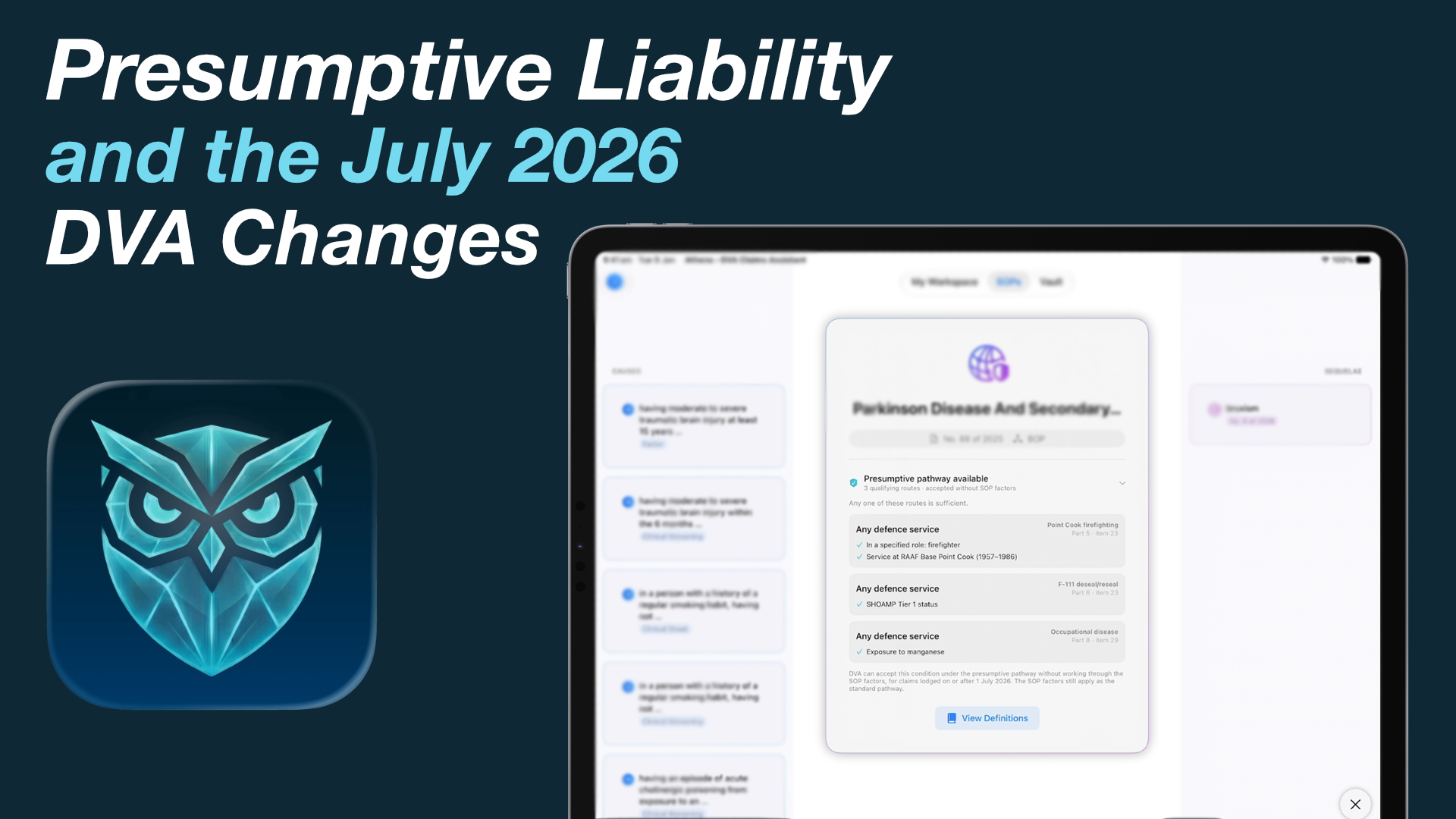
From 1 July 2026, there's a faster way for some DVA (Department of Veterans' Affairs) claims to be accepted. A new legislative instrument — the Military Rehabilitation and Compensation (Injuries and Diseases Attributable to Defence Service—Presumptive Liability) Determination 2026 — introduces presumptive liability for a defined list of conditions. Where it applies, DVA can accept liability for the condition automatically, without the usual standard of proof and without working through Statement of Principles (SOP) factors.
This guide explains, in plain English, what presumptive liability is, how it differs from the SOP pathway, which conditions and service types it covers, and — importantly — who it does and doesn't apply to.
What Is Presumptive Liability?
Presumptive liability is a separate head of liability that runs parallel to the SOP pathway. Normally, to have a condition accepted, you have to connect a diagnosis to the specific factors in the relevant SOP and meet a standard of proof — either "Reasonable Hypothesis" (for operational service) or "Balance of Probabilities" (for peacetime service).
Presumptive liability works differently. When a condition is named in the determination and the veteran meets the relevant service criteria, DVA presumes the condition is connected to service and can accept liability for it. There's no need to argue a hypothesis or work through SOP factors — the connection is presumed by law.
Crucially, this pathway never replaces the SOP pathway. It sits alongside it. If presumptive liability doesn't apply to a particular condition or veteran, the ordinary SOP route is still available exactly as before.
How It Differs From the SOP Pathway
The two pathways answer the same question — "is this condition related to service?" — but they get there very differently:
- Standard of proof: The SOP pathway requires you to meet Reasonable Hypothesis or Balance of Probabilities. Presumptive liability is independent of standard of proof — if the criteria are met, the condition is accepted.
- What you have to prove: The SOP pathway turns on medical factors (exposures, events, timeframes). Presumptive liability turns on service criteria — the type of service, a qualifying period, a prior accepted condition, or a specific exposure.
- What it covers: SOPs cover hundreds of conditions. Presumptive liability covers a defined list of 247 conditions across eight specific service routes.
The 247 Conditions and Eight Service Routes
The determination groups conditions into eight "routes," each with its own key gate — the service-related test that has to be satisfied:
- Specified defence service — service type plus a qualifying period.
- Secondary condition — a prerequisite accepted condition is already in place.
- Service involving abuse — a qualifying redress or reparation payment.
- RAAF Point Cook firefighting — service at Point Cook between 1957 and 1986.
- F-111 deseal/reseal — recognised SHOAMP Tier 1, 2 or 3 status.
- Firefighter cancers — service as a firefighter, with fire-scene exposure.
- Occupational diseases — a period of service plus exposure to a substance or agent.
- Occupational asthma — exposure to a sensitising agent.
A single condition can have more than one qualifying route — for example, peacetime versus warlike or non-warlike service. Meeting any one route is enough.
Who Qualifies — and the Date That Matters
The single most important thing to understand about presumptive liability is the date. The determination applies only to claims lodged on or after 1 July 2026. A claim lodged before that date is assessed under the existing pathways, even if the condition appears on the presumptive list.
So presumptive liability is not retrospective. If you're a veteran or advocate weighing up a claim, the lodgement date determines whether this pathway is even on the table. Beyond the date, qualifying comes down to whether the veteran's service satisfies the key gate for one of the routes above.
The Honest Part: "Not Assessable"
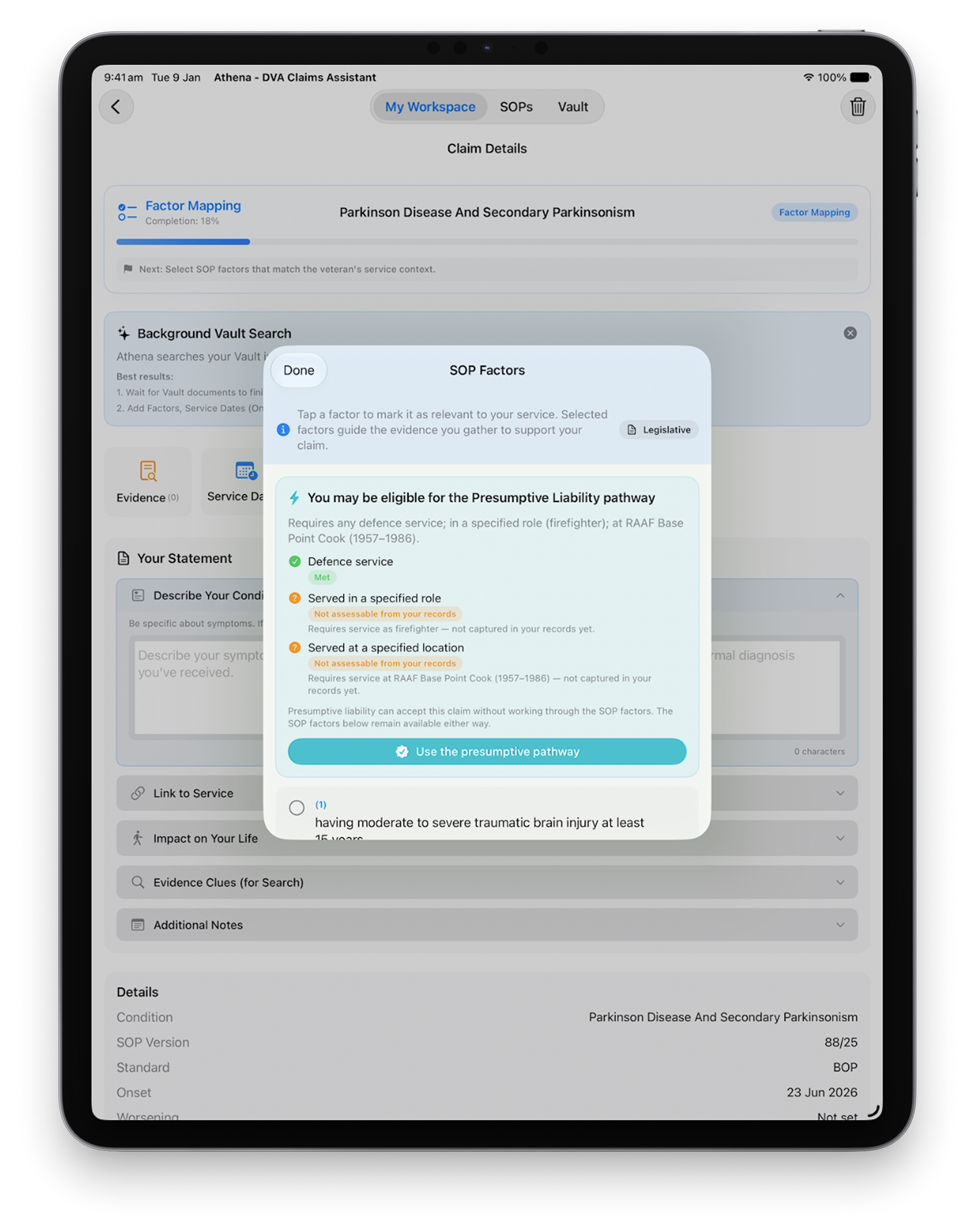
Not every criterion can be confirmed from service records alone. Some gates — a specific posting, a SHOAMP tier, a redress payment, a chemical exposure — depend on information that may not be captured anywhere in the file. A responsible assessment flags these honestly rather than guessing.
That's why the most useful way to think about each criterion is as a three-state check: Met, Not Met, or Not Assessable. "Not Assessable" isn't a failure — it's a signal that a gate needs to be confirmed (often by DVA) before the pathway can be relied on. Treating it as a real, load-bearing state is what keeps advocates and veterans out of false-confidence territory.
Athena Tie-in: Presumptive Liability, Built In
Athena now models presumptive liability as its own pathway — exactly as the law does. The full determination is loaded on-device alongside the SOP library, so you can see when a faster route may be open without leaving your claim.
With Athena, you can:
- See when a pathway may be available: Every condition on the list surfaces a quiet "presumptive pathway available" prompt, with the requirements for each qualifying route laid out in plain English.
- Check eligibility honestly: Athena evaluates the veteran's service history against each criterion and returns Met, Not Met, or Not Assessable — never guessing at gates it can't verify.
- Stay in control: The presumptive pathway is never auto-selected. Athena identifies when a veteran may qualify; the veteran confirms it with a single tap, and the SOP factors stay available either way.
- Export with the right citation: Confirmed presumptive claims carry the full instrument citation (Part, item, and F2026L00740) and a liability-basis statement written for the DVA delegate.
- Keep everything private: All of this happens on your iPad or M-series Mac. Service history, eligibility checks, and claim strategy never leave your device.
The result: you can spot the fastest route to acceptance for the right claims, without overstating what a presumption can do.
This guide is general information, not legal advice. Eligibility depends on the full text of the Presumptive Liability Determination 2026 (F2026L00740) and each veteran's individual circumstances. Always confirm details against the current instrument and DVA guidance.
See when a faster pathway may be open.
Available exclusively on the App Store.