How to Organise Years of
Medical Evidence for Your Claim
When it comes to DVA (Department of Veterans' Affairs) claims, the strength of your case rests entirely on the quality and organisation of your medical evidence. In theory, this sounds simple enough. In practice, assembling a timeline of a veteran's medical history often feels like putting together a jigsaw puzzle where half the pieces are missing and the other half are damaged.
In this guide, we'll explain why chronological timelines matter, the common struggles of scattered records, and how to effectively and securely navigate the mountain of medical paperwork necessary for a successful DVA claim in Australia.
The Struggle of Scattered Records
A veteran’s medical history rarely fits neatly into one file. It might span multiple decades, different branches of the Australian Defence Force (ADF), various deployments, and countless civilian doctors.
If you are an advocate or a veteran managing a claim, you're likely dealing with:
- Printed, faded medical records stacked in boxes
- Emails with massive PDF attachments
- USB drives containing gigabytes of scans
- Discharge summaries, specialist letters, GP notes, and psychological assessments
Manually sorting through this chaos is the most tedious and error-prone part of the DVA process. Because the DVA requires a direct, medically substantiated link between an injury or illness and military service (as per the Statements of Principles or SOPs), missing a single mention of an injury in a 10-year-old doctor's note could mean the difference between an accepted and rejected claim.
Why Chronological Timelines Matter
The DVA doesn't just need to know what the condition is; they need to know when it started and how it developed. This is known as establishing the "clinical onset."
Many RMA factors have strict timeframes attached. For example, a condition might only be claimable if a specific event occurred within two years of the clinical onset. Without a meticulously constructed, chronological timeline of medical diagnoses and service events, it is impossible to accurately match a veteran's history to the SOP factors.
Organizing your evidence chronologically allows you to:
- Spot gaps in medical history that need further investigation
- Clearly demonstrate clinical onset and progression
- Build a compelling narrative that aligns perfectly with the relevant legal criteria
The Privacy Problem with Cloud-Based Tools
When faced with hundreds of pages of PDFs, the temptation is to use online tools, cloud-based summarizers, or public AI models (like ChatGPT) to help organize the data.
This is a massive risk.
Veteran medical records contain highly sensitive, personally identifiable health information (PII/PHI) and classified service histories. Uploading these documents to a third-party cloud server to generate summaries or timelines often violates the Australian Privacy Act and risks data exposure.
You need a way to organize this data intelligently without compromising privacy.
The Athena Advantage: On-Device AI for Medical Records
Athena is built specifically to solve the evidence organisation problem for DVA claims, without ever risking veteran data.
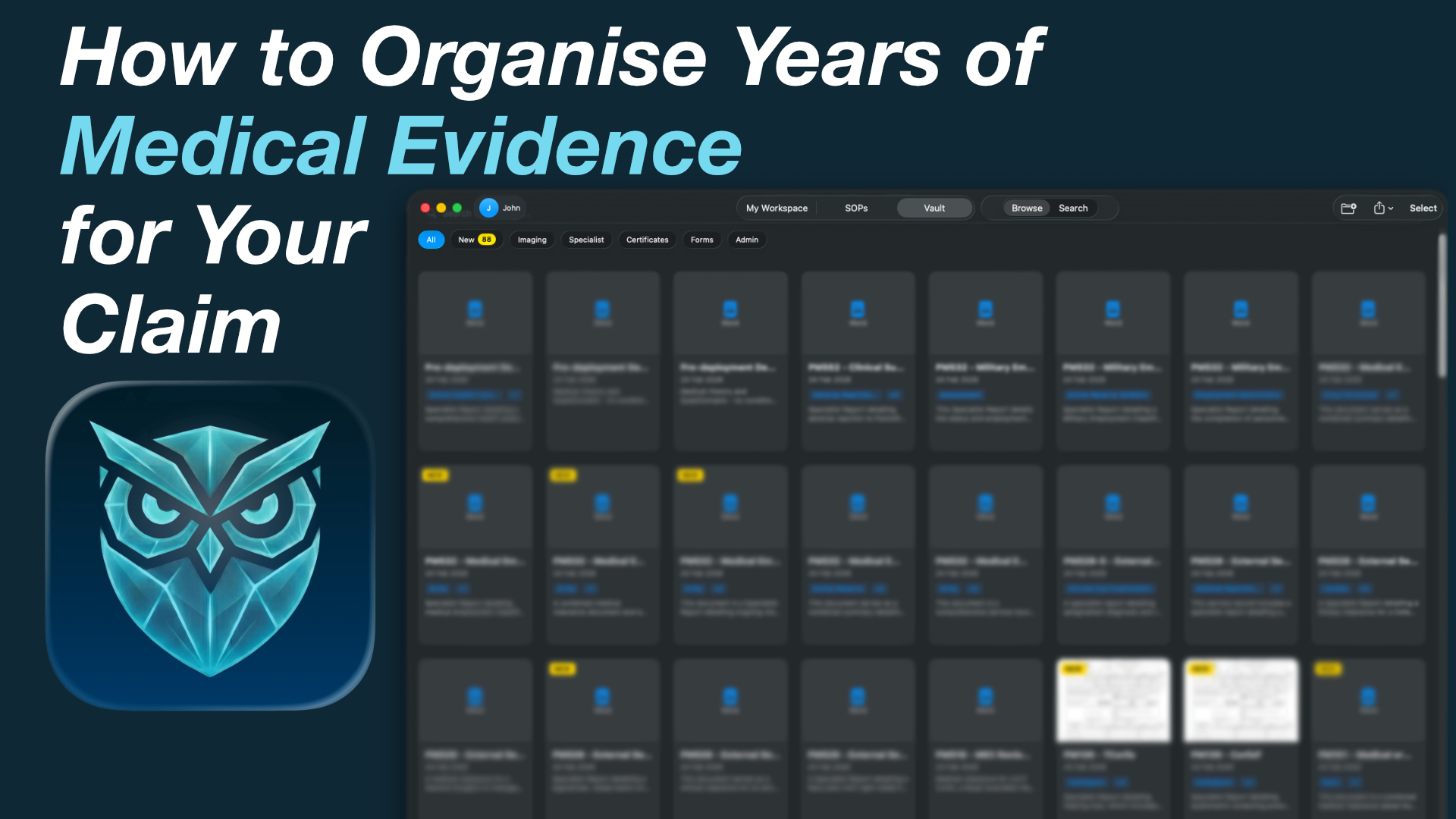
Instead of uploading files to the cloud, Athena uses powerful on-device AI that runs entirely locally on your iPad or M-series Mac. It acts as your personal, highly secure Evidence Vault.
Here’s how Athena transforms the evidence organisation process:
- Automatic Document Tagging: When you import a medical file—whether it's a 50-page PDF or a single doctor's note—Athena reads it locally. It automatically reads through the text, tagging conditions, dates, and diagnoses.
- Instant Timeline Building: As it tags these details, Athena automatically builds a chronological timeline of service and clinical onset. It maps diagnoses alongside service records, giving you an immediate, bird’s-eye view of the claim history.
- Effortless Claim Bundling: When a document proves relevant to a case and you build your claim statement, Athena automatically organizes and references it. When it's time to submit, the legwork is already done—the evidence is perfectly bundled and appended to your final PDF export without any manual sorting.
- Zero Data Egress: Because the AI runs on the device processor, your sensitive medical records never touch a cloud server. Not once. Not ever. It is the ultimate combination of cutting-edge efficiency and uncompromising data privacy.
Stop manually highlighting printouts and scrolling endlessly through PDFs. Securely organize your evidence with Athena.
Ready to take control of your medical evidence securely?
Available exclusively on the App Store.